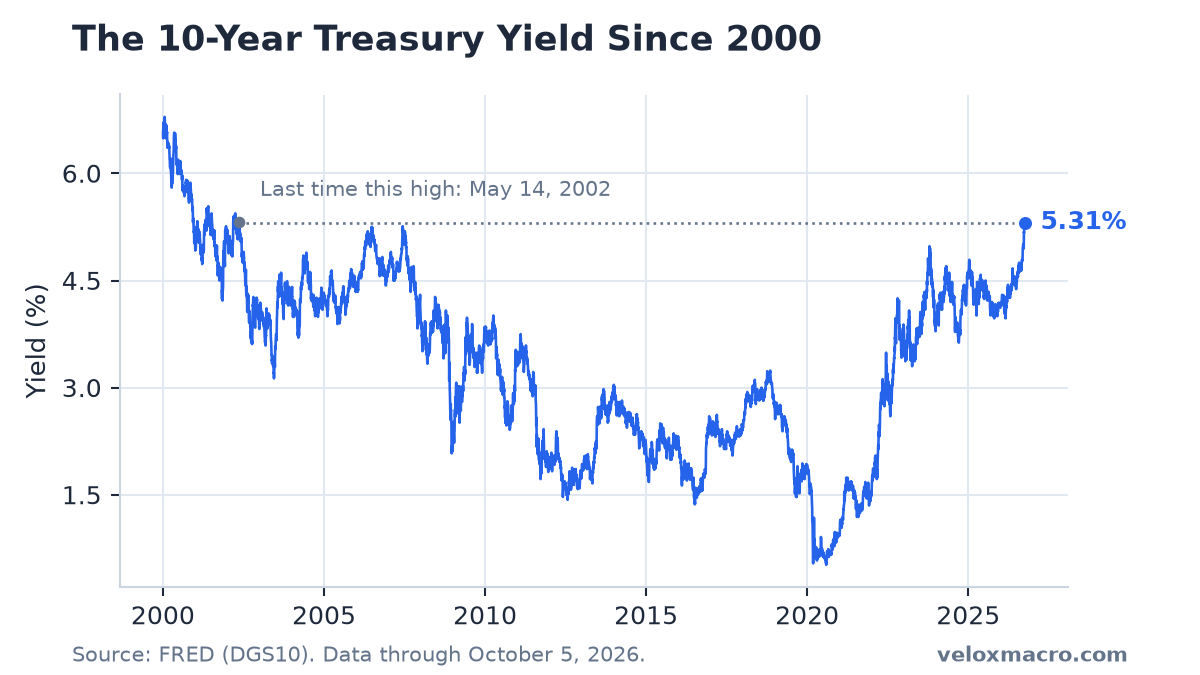
The 10-Year Pauses Near 5.3%, and the Rise Is All Real Yield
The 10-year Treasury yield slipped to about 5.27% on Tuesday, October 6, a day after closing at 5.31%, its highest close since May 2002. Over the past week it has barely moved. The more useful finding is underneath: since early September, almost the entire rise in the 10-year has come from real yields, while the market’s inflation expectations have not changed. Meanwhile SPY closed at a record for the first time since August 13, and 30-year mortgage rates have climbed above 7%.
New to Treasury yields? Start with our complete guide to the 10-year yield and weekly archive.
Key Market Data (session close: October 6, 2026)
The tables below reflect the Tuesday, October 6, 2026 U.S. close. Weekly changes run from the September 29 close. ^TNX is the market quote we use as the main 10-year reading. FRED’s daily Treasury series are published about one business day later, so their latest values are for Monday, October 5. The mortgage rate is Freddie Mac’s weekly survey.
| Ticker | Close | Daily % Change | Weekly % Change |
|---|---|---|---|
| SPY | 779.09 | +0.55% | +1.95% |
| QQQ | 759.66 | +0.46% | +2.94% |
| AAPL | 333.63 | +0.22% | +1.28% |
| MSFT | 529.30 | +0.78% | +4.00% |
| NVDA | 239.24 | +0.14% | +5.29% |
| TSLA | 380.68 | +0.51% | +7.89% |
| Indicator | Latest Value | As Of | Notes |
|---|---|---|---|
| US 10-Year Treasury (^TNX) | 5.27% | 2026-10-06 | Daily -0.79%; weekly +0.27% |
| 10-Year Treasury (FRED DGS10) | 5.31% | 2026-10-05 | Official daily series |
| 2-Year Treasury (FRED DGS2) | 4.84% | 2026-10-05 | Most sensitive to expected Fed policy |
| 30-Year Treasury (FRED DGS30) | 5.66% | 2026-10-05 | Long end of the curve |
| 10-Year TIPS Real Yield (FRED DFII10) | 2.95% | 2026-10-05 | Yield after inflation |
| 10-Year Breakeven Inflation (FRED T10YIE) | 2.36% | 2026-10-05 | Inflation expected by bond investors |
| 30-Year Mortgage Rate (MORTGAGE30US) | 7.28% | 2026-10-01 | Freddie Mac weekly average |
| Effective Fed Funds Rate (DFF) | 3.88% | 2026-10-05 | Up from 3.63% since September 17 |
| VIX Index (^VIX) | 15.01 | 2026-10-06 | Daily -3.29%; weekly -6.42% |
| US Dollar Index (DX-Y.NYB) | 101.83 | 2026-10-06 | Daily -0.33%; weekly +0.45% |
| WTI Crude Oil (CL=F) | $89.44 | 2026-10-06 | Flat on the day and the week |
| CPI Index (CPIAUCSL) | 334.131 | 2026-08-01 | August index level, about 3.4% above a year earlier |
A Week Spent Near 5.3%
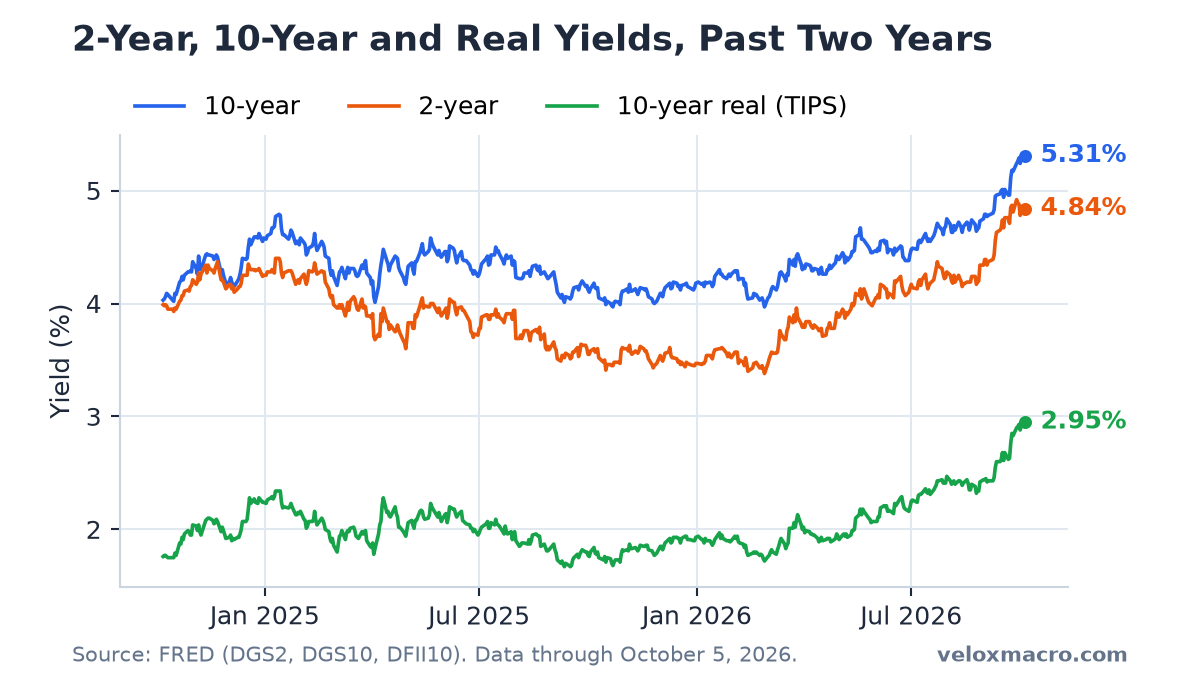
Tuesday’s 0.79% drop in ^TNX works out to about 4 basis points, from 5.31% to 5.27%. Over the full week the yield is up only about 1 basis point. That is a change of pace. The 10-year rose for seven straight sessions through September 30. Its last five closes were 5.29%, 5.24%, 5.28%, 5.31% and 5.27%. The climb has stopped for now, but the yield has given back almost none of its September gains.
Splitting the 10-Year Into Two Parts
A regular 10-year Treasury yield can be split into two pieces using inflation-protected Treasuries, called TIPS. The TIPS yield is the real yield, the return investors get after inflation. The gap between the regular yield and the TIPS yield is the breakeven rate, which shows how much inflation bond investors expect over the next ten years. Add the two and you get, roughly, the regular yield.
Here is how those pieces moved, using FRED’s daily data:
- 10-year yield: 4.80% on September 8, 5.31% on October 5, up 51 basis points.
- 10-year real yield: 2.43% to 2.95%, up 52 basis points.
- 10-year breakeven inflation: 2.37% to 2.36%, essentially unchanged.
The whole rise came from real yields. Bond investors are not pricing in more inflation than they were a month ago. They are demanding a higher return after inflation. That is consistent with expectations of tighter Fed policy, with a higher premium for holding long-term bonds, or with both. These numbers cannot say which. They do argue against one common explanation: this does not look like an inflation scare.
First the Short End, Then the Long End
The 2-year yield, which tracks expectations for Fed policy most closely, rose from 4.39% on September 8 to 4.74% on September 16, the day before the Fed’s quarter-point increase showed up in the effective rate. The 10-year rose less over the same stretch, from 4.80% to 5.01%.
After that the roles switched. From September 22 to October 5, the 2-year rose 13 basis points while the 10-year rose 35 and the 30-year 37. The gap between the 10-year and 2-year yields, which had narrowed to about 25 basis points on September 22, widened to 47. In plain terms, the Fed’s move pushed up short-term rates first, and then long-term rates did most of the climbing on their own.
Mortgages Above 7%
Freddie Mac’s weekly survey put the average 30-year mortgage rate at 7.28% on October 1, the highest reading since November 2023. It was 6.71% on September 3. Mortgage rates usually sit 1.5 to 2 percentage points above the 10-year yield, and the latest spread is about 2.0 points, at the top of that range. The next survey comes out on Thursday, with the 10-year still near 5.3%.
Stocks at Records Anyway
SPY rose 0.55% on Tuesday to 779.09, edging past its August 13 record close of 777.88. QQQ and NVIDIA also closed at records, and the VIX fell 3.29% to 15.01. Over the week Tesla gained 7.89%, NVIDIA 5.29% and Microsoft 4.00%.
Higher real yields are normally a headwind for stocks, because they raise the return investors can lock in without taking equity risk. So far the stock market has looked past that. Whether it keeps doing so with real yields near 3% is the main question these numbers raise.
What to Watch
- September CPI, due in mid-October. A hot reading could lift the breakeven rate for the first time in this move, adding inflation expectations on top of higher real yields.
- Monday’s 5.31% close. A close above it would restart the climb. A move back below 5.2% would suggest the peak is in for now.
- The real yield near 3%. It drove the entire September move. Watch it more closely than the headline yield.
- Thursday’s mortgage survey. Another reading above 7% would keep mortgage rates at their highest level in almost three years.
This is not financial advice.